
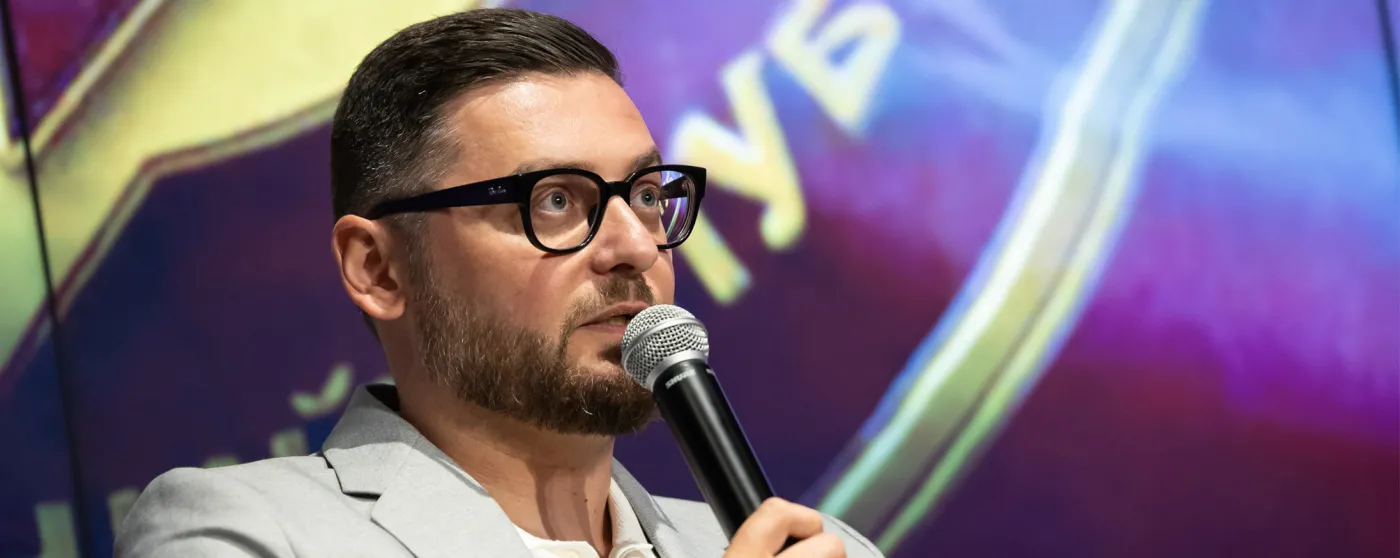
Yurii Korotun: "This is a fundamental work that lasted almost two years"
The new stage of the club's development is the result of long-term work that covered all areas of activity - from strategy and positioning to visual system and infrastructure. Vice President of the club Yuriy Korotun shared about the path to this decision, its prerequisites, and the future of the football club "Kharkiv."
— The rebranding has already taken place, and the club has been living in a new reality as "Kharkiv" for several days, so to speak. When did this work start within the club?
— This story began much earlier than it may seem from the outside. What is now a fact and a new reality for the club is the result of long and complex work that took about two years and has been evolving since the club was created. It was not a process where we made a decision once and started implementing it. On the contrary, it was a constant work of returning to basic questions, with doubts and checks. We asked ourselves many times: is this really necessary, does it correspond to the path the club has been following for many years, will it help us better realize our ambitions in the future. Only after we went through this internal path and honestly answered these questions, this decision became reasoned and confident for us.
For me personally, this is also a very important and lived stage. I worked at that "Metalist," was in the club when it disappeared, and was there when "Metalist 1925" appeared. And now, as the club acquires a new identity, sets much higher goals and ambitions, I can say that this is a logical and correct step. I have great respect for both "Metalist" with its history and heritage, and "Metalist 1925" and the people who did not let Kharkiv football disappear in 2016. It is important to understand that the club today, created in 2016, is an independent project that continues to develop and shape its own history, rather than living within the boundaries of the past.
Alongside this, there was a lot of practical work that was not visible from the outside. This includes values, positioning, visual system, and all physical infrastructure of the club - uniforms, merchandise, stadium, office, transportation. It involves legal processes, approvals, and registrations. It is communication preparation so that everyone speaks with one voice at the moment of announcement. It is dozens of decisions that needed to be integrated into one system.
As of today, the club is already living as "Kharkiv," and this feeling is very clear - we understand that this is not the beginning of changes but their result.
— What exactly did you research before making the final decision?
— We looked at this issue comprehensively, and this is one of the reasons why the process could not be quick. On the one hand, we analyzed the external perception of the club - how fans see us, how the media perceives us, the football community in Ukraine and beyond. It was important not just to intuitively feel but to document that the problem of confusion and blurred identity is systemic and does not disappear over time. On the other hand, we looked very carefully inside - at who we have become as a club, what goals we set for ourselves, and what level of responsibility we take. At some point, it became obvious that the actual scale of the club and its perception were starting to diverge, and it was no longer a matter of communication or marketing but a matter of foundation. It was at this point that we realized that without deeper changes, it would be difficult to move forward.
— How unique is this case for football?
— Looking at modern football, such comprehensive changes do not happen often. Most clubs limit themselves to individual updates - a logo, visual identity, or communication. In our case, it is a more extensive process that resulted from the club's long-term development and gradually formed over a long time. It is not a single decision at one point but a logical continuation of the path the club has been on since its creation. That is why we are talking not about a sharp turn but about a consistent transition to the next stage of development.
Similar transformations have occurred, but at the early stages of club formation. For example, London's "Arsenal" was founded in 1886 as Dial Square, "Manchester United" started as Newton Heath, and "Manchester City" as West Gorton. And why go far. If we talk about our native city of Kharkiv, the club we all know as "Metalist" was founded in 1925, but it was only named that in 1967, before that, it had other names - KHPZ, "Dzerzhinets," "Avangard." So even locally, we see that the identity of football clubs was formed over time and changed with the context.
Today, such decisions are made much less frequently and are much more difficult to implement because clubs already have established brands and a long history.
— Is it correct to understand that this is much broader than just a name change?
— It is much more than just a name change. The name is only what is visible on the surface. In reality, it is a large comprehensive work that covers almost all levels of the club. It starts with the sense and answering the question of who we are and what we represent. Then it transitions into visual language, identity, colors, symbols. But it does not stop there. It includes physical changes - uniforms, merchandise, banners, stadium decoration, office, transportation. It involves legal processes that require time and precision. It is internal processes and communication. And when you go through this, you begin to understand that rebranding is not about a partial name change or some elements but about aligning the entire system with the level at which the club is today.
— What was the most challenging part of this process?
— The most challenging part is to maintain a balance and not make this step either too early or too late. When you see that changes are needed, there is a natural desire to speed up the process. But at the same time, you understand that any ill-considered decision at this level can have long-term consequences. That is why we consciously moved through checking each stage. We revisited basic questions many times: what are we doing, why are we doing it, and how will it be perceived not only now but in a few years. It required time and patience, but this allowed us to make the decision systematic, evolutionary, rather than situational.
— What does this rebranding give the club in practical terms?
— Primarily, clarity and a foundation for further development. When the club has a clear identity, it affects all processes - from internal work to how it is perceived externally. The need to constantly explain who you are disappears, and the opportunity to build a long-term strategy arises. It also opens up new possibilities - in the sports field, in working with partners, in interacting with fans. And separately, it is important that it allows for a clearer understanding that the football club "Kharkiv" is a place that unites people.
Those who live in the city, who are connected to it, who have left but continue to feel it as their own. It's not just about the team, it's about a community that has a common center of gravity.— What is key for you in how the club and fans will experience this transition to a new stage?
— This is a very natural process, and it is important to understand it correctly. People always react cautiously to changes, especially when it comes to something they are used to and emotionally connected to. Almost any updates are initially perceived critically - this is a normal reaction. We have seen this in Ukrainian and global football, even when it was just about changing the logo. But over time, something else happens - there is understanding, a sense of belonging, self-identification, and a new stage begins to live fully. But at the same time, this opens up new opportunities - for sporting ambitions, for brand development, for building a stronger community. And here, the key for us is not to convince everyone at once, but to consistently show that this step makes sense and brings results. We are confident that over time, the football club "Kharkiv" will be perceived as a natural and strong point of unity for everyone connected to the city and who feels part of it.